

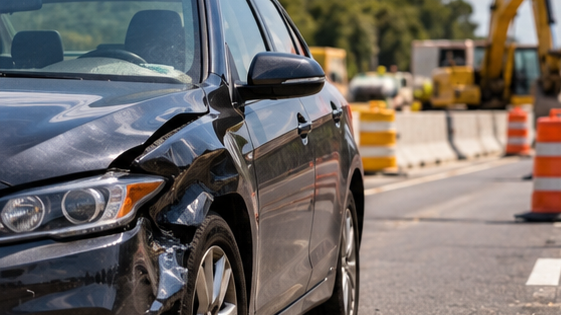
You were driving through a highway work zone when traffic suddenly narrowed, a lane shifted, a barrier appeared closer than expected, or another vehicle moved into your path.
Maybe a driver hit you while merging. Maybe construction equipment blocked your view, temporary pavement markings were difficult to follow, or traffic was being redirected around active roadwork when the crash happened.
Afterward, it can be easy to assume that the claim begins and ends with the other driver.
Sometimes it does. But a work-zone crash can involve additional questions about how traffic was being controlled, whether temporary signs and barriers were properly placed, whether the roadway created an unexpected hazard, and who was responsible for the work being performed.
In Tallahassee and elsewhere in Florida, identifying those details can help determine whether someone besides another motorist needs to be investigated after a highway work-zone accident.
Why Can a Highway Work-Zone Crash Involve More Than Another Driver?
Construction changes the roadway drivers normally expect.
A familiar highway can suddenly have narrower lanes, shifted traffic patterns, reduced shoulders, temporary pavement markings, concrete barriers, construction vehicles entering traffic, or workers directing vehicles through an altered route.
Those conditions do not automatically make a contractor, engineer, or government agency responsible when a crash occurs. Drivers still have a duty to respond reasonably to traffic and roadway conditions.
But the work zone itself can become part of the liability analysis when the way it was designed, maintained, marked, or operated contributed to the collision.
That means the investigation should look not only at what each driver did, but also at what was happening on the road immediately before the crash.
Could a Road Contractor Be Responsible?
Potentially, depending on the project and what caused the crash.
A contractor working on a Florida transportation project can have responsibilities for construction, maintenance, repairs, and traffic control. Depending on the contract, that can include temporary barriers, lane closures, signs, pavement markings, construction access points, and other features used to guide drivers safely through the work zone.
For Florida Department of Transportation projects, however, a contractor is not automatically responsible simply because a dangerous condition existed. Florida law can limit a contractor's liability when the contractor complied with contract documents material to the condition that caused the injury.
Those protections have limits. For example, the law does not provide the same protection when a contractor creates a latent condition, defect, error, or omission that was not contained in the contract documents, or when the contractor fails to follow required traffic-control plans and that failure is the proximate cause of an injury.
So the important question is not simply whether a construction company was working at the scene. We need to know what the contractor was responsible for, what the approved plans required, what conditions actually existed when the crash occurred, and whether the contractor's work contributed to what happened.
What Work-Zone Conditions Could Become Important?
The specific condition that affected your driving can be one of the most important parts of a work-zone investigation.
Issues worth investigating can include:
- Temporary signs that were missing, obscured, damaged, or positioned improperly
- Lane shifts that were difficult to identify
- Conflicting or faded temporary pavement markings
- Barriers, cones, or channelizing devices placed in a way that affected traffic movement
- Construction equipment entering or leaving the roadway
- Debris, uneven pavement, drop-offs, or other temporary roadway conditions
- Inadequate warning before a lane closure or merge
- Traffic-control devices that did not match the actual configuration of the work zone
- Sight lines obstructed by equipment, barriers, materials, or temporary structures
- A flagger or other traffic-control operation that contributed to confusion
The presence of one of these conditions does not establish negligence by itself. The important questions are whether the condition existed when the crash occurred, who was responsible for it, what the applicable plans or requirements called for, and whether it actually contributed to the collision.
What if Construction Equipment or a Work Vehicle Was Involved?
If a dump truck, construction vehicle, piece of equipment, or other work vehicle was directly involved in the collision, another layer of investigation can become necessary.
We may need to determine who owned the vehicle, who operated it, what company employed or contracted with the operator, and what the vehicle was doing when the crash occurred.
For example, there is a difference between a passenger vehicle colliding with another car while passing through a work zone and a crash caused when construction equipment enters an open traffic lane from a work area.
The vehicle's movement, visibility, warning devices, operator conduct, and relationship to the project can all become relevant.
The same is true when equipment never physically touches a vehicle but blocks a driver's view or forces traffic into an unexpected maneuver.
At Brooks LeBoeuf, we examine how the vehicle or equipment was being used, who controlled it, and how that activity fit into the larger project so we can determine whether it contributed to the crash.
Could FDOT or Another Government Entity Be Involved?
Possibly.
Some highway projects are overseen by the Florida Department of Transportation, while other roads can involve counties, cities, or other public entities. A public agency can have responsibilities connected to a roadway or transportation project, but claims involving government entities are subject to rules that differ from ordinary negligence claims.
Florida has waived sovereign immunity for certain tort claims against the state and its agencies or subdivisions, but only within the requirements and limitations established by law. Claims can involve special notice procedures, deadlines, defenses, and limitations on recovery.
That means identifying the public entity connected to a project can matter early.
It also does not mean that a government agency is automatically responsible simply because the crash happened on a public road or within a government-funded project. The specific act or condition alleged to have caused the crash still has to be examined.
Can More Than One Party Share Responsibility for a Work-Zone Crash?
Yes. A single collision can involve separate acts by different people or entities.
For example, another motorist might make an unsafe lane change, while a poorly maintained traffic-control setup also contributes to the circumstances of the collision. In another case, the driver's conduct may be the primary cause even though construction was underway nearby.
Florida generally apportions fault in negligence cases according to each responsible party's percentage of fault. Under current Florida comparative fault law, a person who is found more than 50 percent responsible for their own harm generally cannot recover damages in an ordinary negligence action subject to the statute.
That makes it important not to treat a work-zone crash as an either-or question between “the driver” and “the construction company.”
The evidence needs to show what each person or entity actually did and how those actions combined to cause the crash.
What Evidence Can Show How the Work Zone Was Set Up?
Work-zone conditions can change quickly.
Cones move. Signs are relocated. Lane closures change. Equipment leaves the site. Pavement markings can be added or removed as the project progresses.
That makes early documentation especially valuable.
Depending on the crash, useful evidence can include:
- Photographs or video of the work-zone layout
- Temporary signs, cones, barriers, and pavement markings
- Dashcam or nearby surveillance footage
- Police crash reports
- Witness statements
- Construction and traffic-control plans
- Project records and daily work logs
- Records showing lane closures or changes in traffic patterns
- Information identifying the contractor and subcontractors
- Photographs of roadway defects, debris, drop-offs, or other temporary conditions
- Data or records from vehicles involved in the collision, when available and legally obtainable
If you can safely document the scene immediately after the crash, photographs showing what traffic looked like from a driver's perspective can be particularly useful.
Later photographs may show a completely different configuration.
What Should You Do After a Highway Work-Zone Crash?
Your immediate priority should be your health. Seek appropriate medical care and follow the recommendations you receive.
If you are able to do so safely, document the broader scene as well as the vehicle damage. Photographs or video showing the traffic pattern, roadway conditions, construction activity, and your direction of travel can help preserve what the work zone looked like when the crash occurred.
Keep the crash-report information, photographs, medical records, repair estimates, and documents showing missed work or other accident-related losses. If you know the name of the construction company or see a project sign identifying a contractor or government agency, preserve that information, too.
Do not assume that the police report will identify every person or entity whose conduct needs to be examined. A crash report can document important facts, but it may not show who was responsible for the traffic-control plan, who maintained temporary signs or barriers, or whether the work zone matched the applicable project requirements.
Those questions can require a separate investigation.
Injured in a Tallahassee Highway Work Zone? Brooks LeBoeuf Can Help Determine What Needs to Be Investigated
When you are injured in a highway work zone, determining what the other driver did is often only one part of understanding how the crash happened.
At Brooks LeBoeuf, we can investigate the collision, document the conditions that existed in the work zone, identify the contractors, public entities, vehicle operators, or other parties connected to the project, and examine whether their conduct contributed to your injuries.
We can also review available traffic-control and project records, evaluate the insurance and legal issues involved, and help you understand what options are available based on the facts of your situation.
If you were injured in a highway work-zone crash in Tallahassee or beyond, contact Brooks LeBoeuf to discuss what happened and what steps make sense next.
Disclaimer: Results may vary depending on your particular facts and legal circumstances. The articles on this blog are for informational purposes only and are no substitute for legal advice or an attorney-client relationship. If you are seeking legal advice, please contact Brooks, LeBoeuf, Foster, Gwartney, Hobbs, Fusco & Richards, P.A. directly.